

October 9, 2026
It’s a well-known fact that Washington needs to build over a million new housing units by 2040 just to meet demand. Despite this, many local governments continue to lag in approving permits for new single- and multi-family homes.
The state has released its second annual permitting performance report, revealing a more complex picture of permitting efficiency across Washington in 2025. These reports are required under SB 5290, a 2023 law spearheaded by BIAW that established permit review deadlines and annual performance reporting to improve transparency, accountability, and permitting efficiency. The first report, analyzing 2024, found that many local governments were not processing permits within legally required timeframes. This year's report, analyzing 2025, shows both areas of improvement and continued challenges.
First, the good news: Permitting performance improved in 2025.
Across the jurisdictions required to report, median permit review times improved approximately 19% compared to 2024. In 2024, permits were processed at a median of 17 days slower than statutory timelines. In 2025, the median flipped to 13 days faster than statutory timelines — roughly a month faster. The number of jurisdictions meeting or beating statutory timelines also increased from 33 to 42.
That is encouraging progress and evidence that deadlines, transparency, and accountability can move the needle.
However, it’s always a good idea to read the fine print.
Below are key takeaways from Commerce’s updated report:
- The state is measuring a much smaller slice of the permitting process this year. Jurisdictions reported 2,774 permit decisions in 2024, compared with just 1,731 in 2025. Commerce attributes much of that decline to HB 1935, which removed building permits from the SB 5290 reporting requirements. In other words, the drop does not necessarily mean fewer permits were issued—it means fewer permits are now being measured.
- Not every category has improved. Multifamily housing permits requiring both notice and hearing were 20.34 days slower.
- Most permit types still exceed statutory deadlines when measured by average processing time.
- Some of the biggest reported improvements are not necessarily apples-to-apples. Preliminary subdivisions improved by 116.5 median review days and final subdivisions by 33.45 days, but Commerce says those gains are largely influenced by a change in how subdivision review cycles were reported in 2025.
- Tumwater reported an 180-day deadline for construction permits requiring no notice or hearing—a process with a 65-day statutory deadline. However, Tumwater did get closer to the statutory deadline than those implications, averaging 68.33 days to process construction permits.
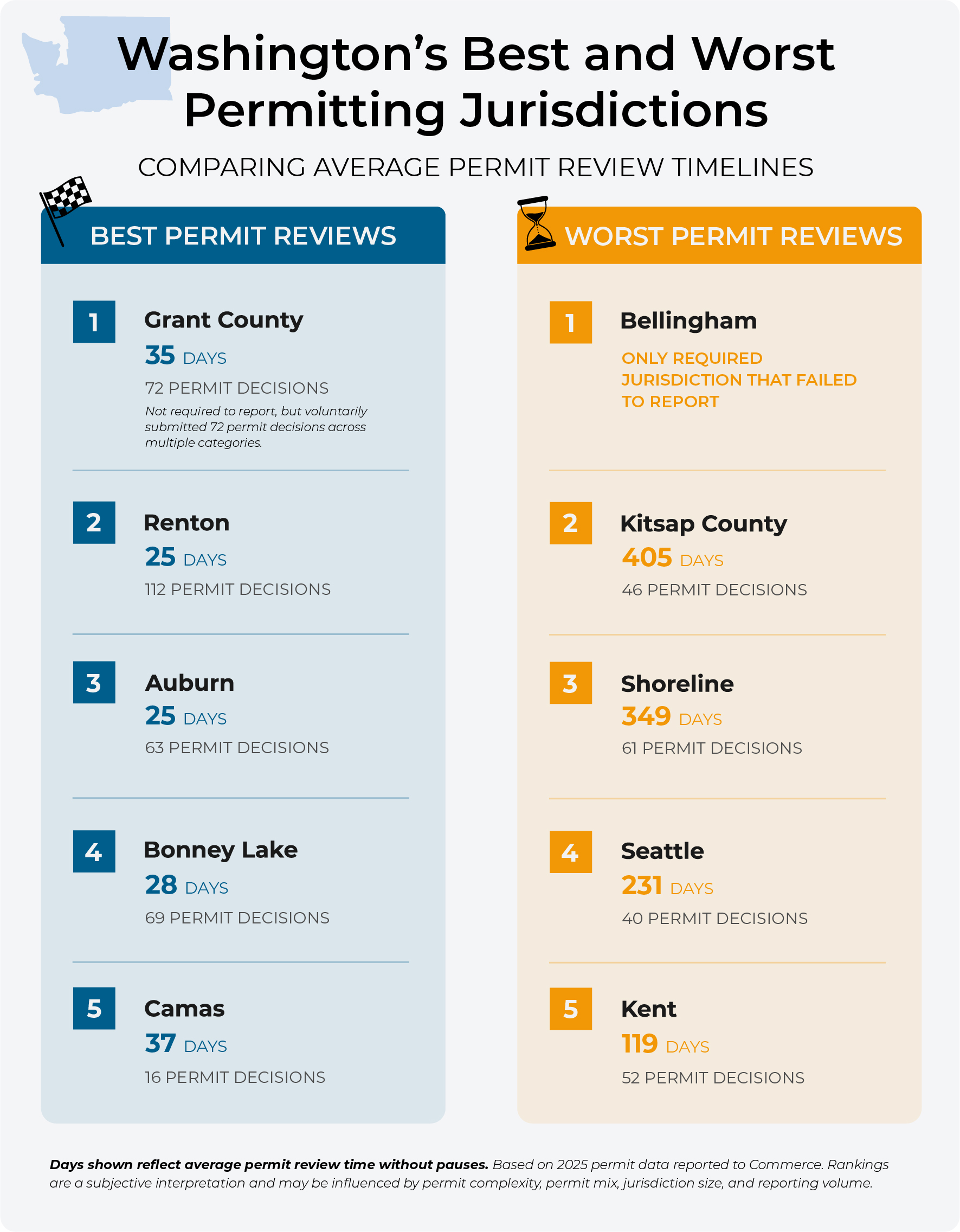
- Kitsap County remains a serious outlier. Of its 46 reported permit decisions, 40 exceeded the applicable deadline. Average active review time was 405 days, and preliminary subdivisions averaged 441 active review days. Multifamily permits averaged 449 active review days.
- Seattle also has substantial work to do. Of 40 reported decisions, 28 exceeded the deadline. Thirty-five of those decisions were multifamily housing permits, which averaged 257 active review days and 789 calendar days when pauses were included.
- Kent reported 21 of its 52 decisions exceeding deadlines. Preliminary subdivisions averaged 217 active review days, and final subdivisions averaged 144 active review days.
- Burien reported only four decisions, so its sample is small—but all four exceeded the deadline. Its three multifamily decisions averaged 171 active review days, while its single construction permit took 326 active review days.
- Bellingham was the only required jurisdiction that failed to submit its 2025 performance report. Commerce received reports from 50 of the 51 jurisdictions required to participate.
- Whatcom County’s extraordinary numbers need context. The county reported only two decisions, and one involved a phased subdivision that had been in process for roughly 10 years with a mutually agreed-upon decision date.
- Reporting issues continue to affect the data. Commerce continues to report incomplete and inconsistent submissions, including missing deadlines, altered reporting templates, late reports, outdated tracking systems, and confusion over reporting requirements. In some cases, Commerce had to assume statutory deadlines when jurisdictions failed to provide them.
- Intake delays can fall outside the official review clock. Some jurisdictions conduct preliminary intake or completeness screening before accepting an application as complete, and time spent in that stage may not appear in the reported active review period. As a result, applicants can experience substantially longer end-to-end permitting timelines than the official performance measures indicate.
Progress should be recognized, but not confused with mission accomplished
SB 5290 appears to be doing what its supporters intended: putting measurable deadlines on local permitting processes, increasing transparency and creating pressure for improvement.
The statewide numbers are better. That deserves recognition. However, the report also indicates that substantial work is yet to be done to improve permitting timelines, which remains one of the key barriers to housing attainability — particularly as 3 in 4 Washington households are still unable to afford the median priced home.